
Waukesha County Circuit Court Overview
A quick note on naming clears up a common search. Some people look for a Waukesha County district court, but Wisconsin does not have one. The state uses a single trial court, the circuit court, for state cases. So the county's trial court is the Waukesha County Circuit Court, and that is where the records on this site live.
The circuit court has original jurisdiction over civil, criminal, probate, juvenile, traffic, and jury-trial matters. Judges are elected to six-year terms, and caseloads rotate among the branches each year, usually in early August. The county's official pages name the current judges and assignments.
That yearly rotation is worth keeping in mind. A case can stay open across an August reassignment, so the judge listed at filing may not be the judge at trial. The record follows the case, not the judge, so a branch change does not move or hide the file. The Clerk of Circuit Court keeps the official record no matter which branch hears the matter.
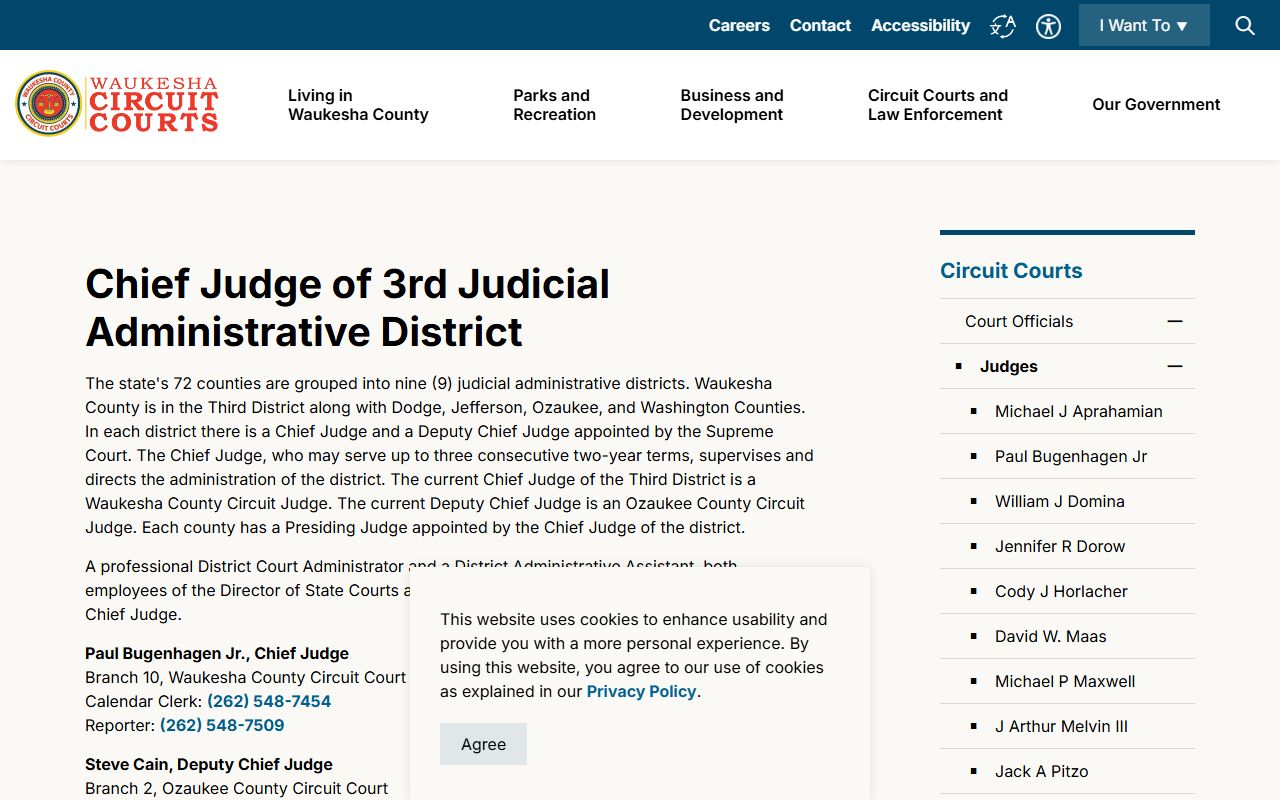
The county's judges page lists the Chief Judge, Presiding Judge, and branch assignments.
List of Waukesha County Circuit Court Branches
The county runs 12 circuit court branches, each assigned to a division such as Criminal/Traffic, Civil, Family, or Juvenile. The table lists the branches, the assigned judge, and the division. Because assignments rotate yearly, confirm the current judge on the county directory if it matters for your case. Each branch sits in its own courtroom, with its own legal clerk, deputy clerk, and court reporter, so a question about a hearing usually goes to that branch's staff rather than the main line.
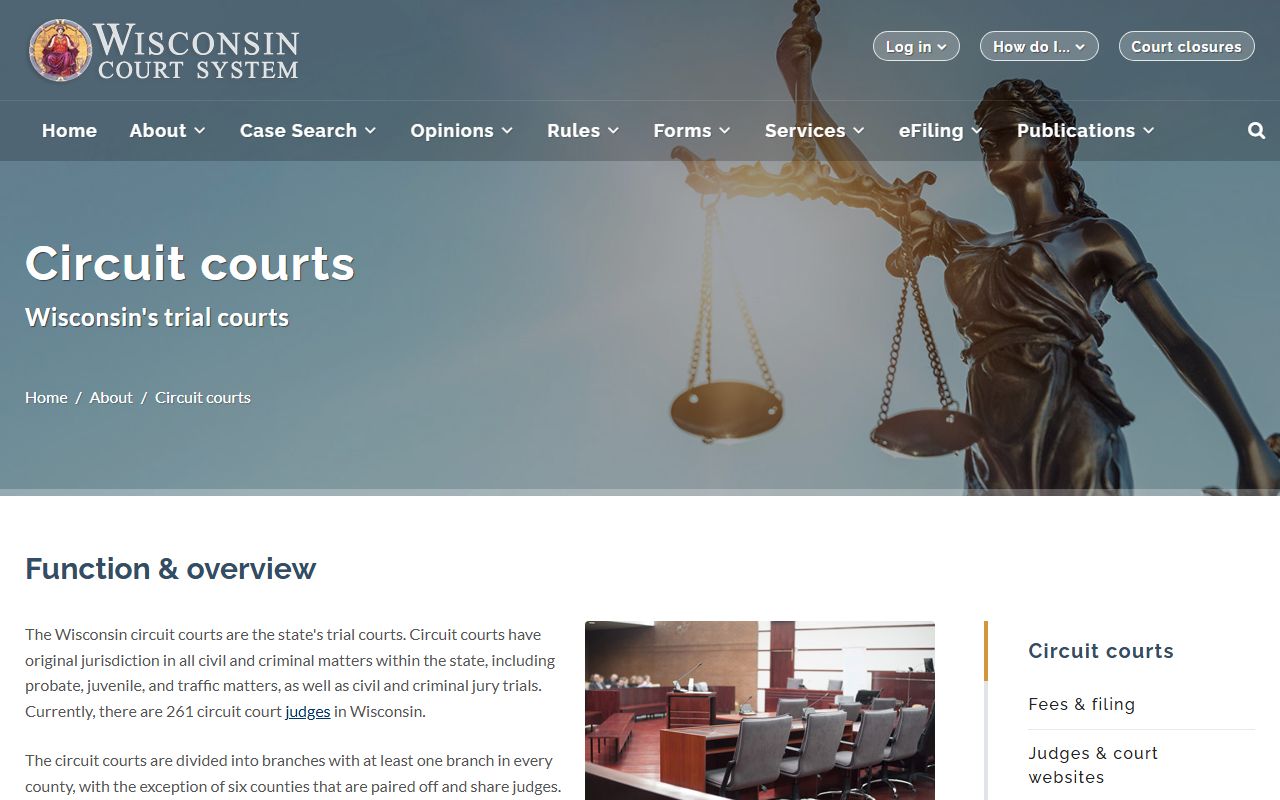
The state's circuit courts page explains the trial-court role that Waukesha County's branches fill.
| Branch | Judge | Division |
|---|---|---|
| Branch 1 | Hon. K. Scott Wagner | Criminal/Traffic |
| Branch 2 | Hon. Jennifer R. Dorow | Family |
| Branch 3 | Hon. Ralph M. Ramirez (Presiding) | Criminal/Traffic |
| Branch 4 | Hon. David W. Maas | Criminal/Traffic |
| Branch 5 | Hon. J. Arthur Melvin III | Civil |
| Branch 6 | Hon. Zachary A. Wittchow | Civil |
| Branch 7 | Hon. Cody J. Horlacher | Juvenile |
| Branch 8 | Hon. Michael P. Maxwell | Criminal/Traffic |
| Branch 9 | Hon. Michael J. Aprahamian | Criminal/Traffic |
| Branch 10 | Hon. Paul Bugenhagen Jr. (Chief Judge) | Civil |
| Branch 11 | Hon. William J. Domina | Criminal/Traffic |
| Branch 12 | Hon. Jack A. Pitzo | Family |
Circuit Court vs. Municipal Court
Wisconsin keeps its trial system simple compared to many states. There is no county court or justice court tier. The circuit court handles state cases, while local municipal courts handle city, village, and town ordinance matters, including many local traffic and forfeiture tickets. The table shows how the two differ.
| Feature | Circuit Court | Municipal Court |
|---|---|---|
| Level | State trial court for the county | Local court for a city, village, or town |
| Cases | Felony, misdemeanor, civil, family, probate, juvenile, state traffic | Ordinance violations and many local tickets |
| Records | WCCA and the Clerk of Circuit Court | The individual municipal court office |
| Appeals | Wisconsin Court of Appeals | Circuit court, on the record or by new trial |
A municipal-court appeal carries its own fee, and the county fee schedule lists a charge for an on-the-record review and a higher charge for a new trial. So a ticket fought in a city municipal court can still end up in the circuit court on appeal, which is one of the few places the two systems meet. For most state cases, though, the circuit court is the first and main stop.
How a Case Moves Through the Waukesha County System
Most cases start and end in the circuit court. A losing party can appeal, and the appeal leaves the county for the state appellate system. The flow is short and clear, and it helps to picture it before you track a case that may move up.
Case flow: Municipal Court / Waukesha County Circuit Court › Wisconsin Court of Appeals › Wisconsin Supreme Court
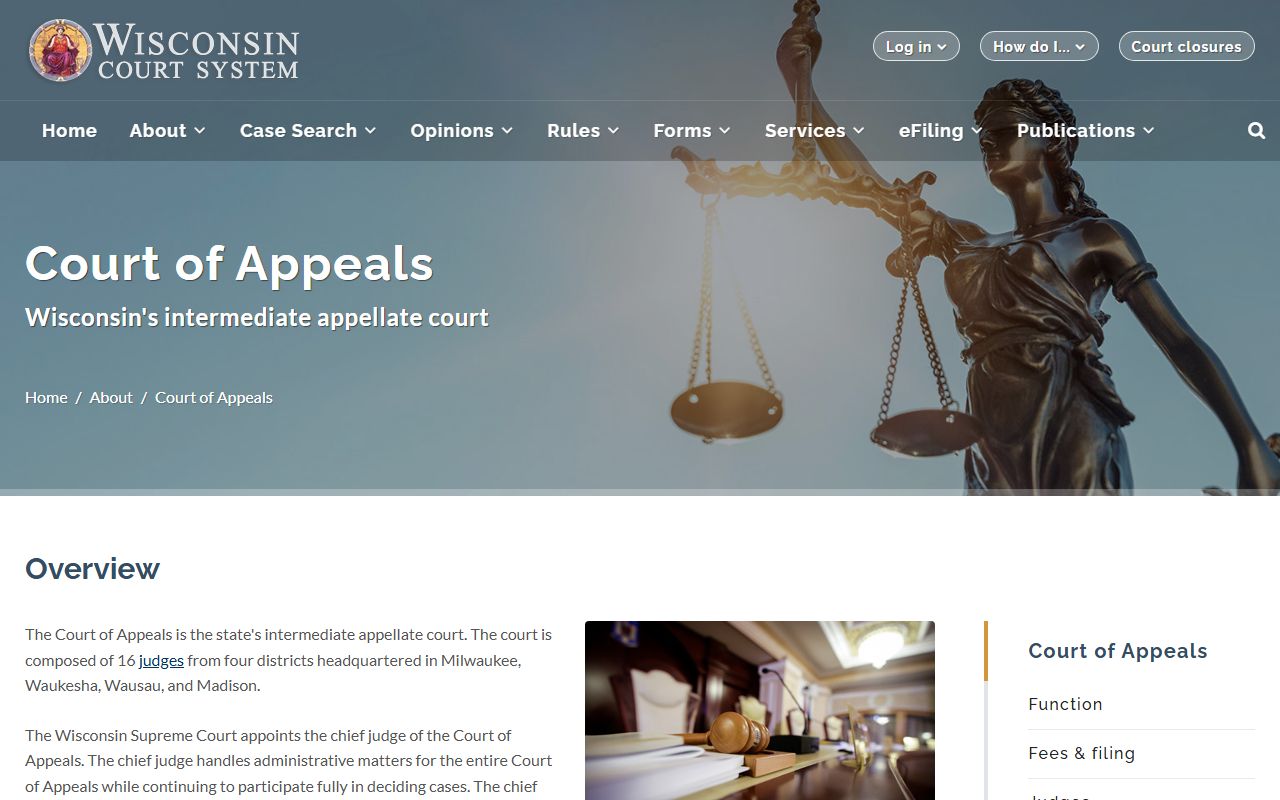
Appeals from the circuit court go to the Wisconsin Court of Appeals, the state's intermediate appellate court.
Appellate cases have their own public search, separate from the circuit court portal. So a case that has moved up on appeal is tracked through the appellate system rather than WCCA.
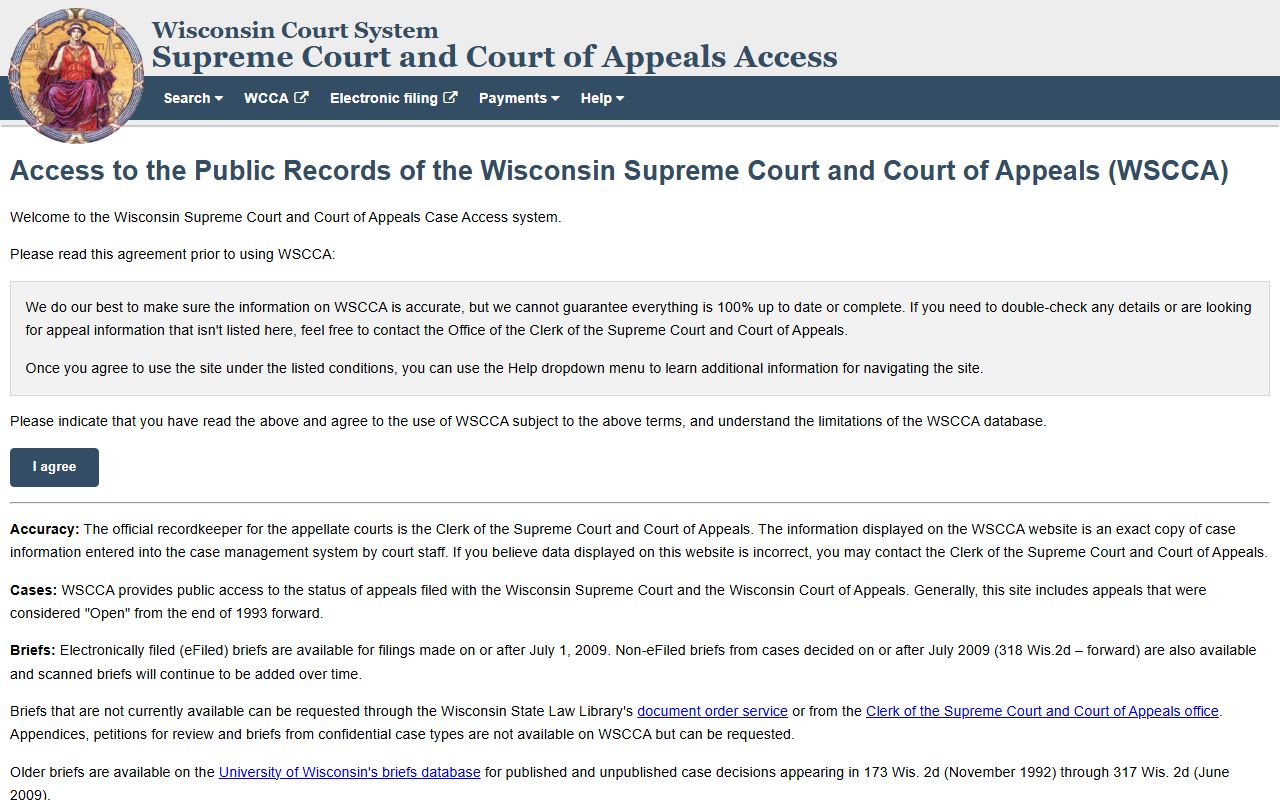
The state's appellate case search covers Supreme Court and Court of Appeals cases.
Civil, Family, Criminal, and Other Divisions
The branches are grouped into divisions by case type, and each division keeps its own counter, phone line, and records. Civil and Small Claims handle money disputes, evictions, and name changes. Criminal/Traffic handles felonies, misdemeanors, and citations. Family handles divorce, custody, and support. Juvenile and Probate round out the set.
This division structure is why a single courthouse can feel like many offices. A divorce filing goes to Family, a foreclosure to Civil, a felony to Criminal/Traffic, and an estate to Probate. The court records page explains how to search across all of them on WCCA, while the Clerk of Circuit Court page lists the division phone numbers.
Here is what each division handles at a glance:
- Civil / Small Claims - large claims, foreclosures, evictions, garnishments, and name changes.
- Criminal / Traffic - felonies, misdemeanors, and traffic citations filed in circuit court.
- Family - divorce, legal separation, custody, placement, and support.
- Juvenile - delinquency, CHIPS, and minor matters, with strict confidentiality.
- Probate - estates, wills, trusts, guardianships, and protective placements.
Public access computers in each of these divisions show Waukesha County case information, which is useful when a document is not posted online.
The Third Judicial Administrative District
Waukesha County sits in Wisconsin's Third Judicial Administrative District, grouped with Dodge, Jefferson, Ozaukee, and Washington Counties. A Chief Judge oversees the district, and the role is currently held by a Waukesha circuit judge. The county also names a Presiding Judge for local administration.
Beyond the elected judges, the court uses court commissioners to handle many hearings, from small claims to family and probate matters. Commissioners take some of the load off the branches and keep cases moving. Their support staff have direct lines for scheduling, which the county directory lists alongside the branches.
The administrative district is more than a label. It shares judicial resources and a Chief Judge across the five member counties, which helps with coverage when a judge is unavailable or a case needs reassignment. For a Waukesha County resident, though, the day-to-day court is local: the case is filed, heard, and recorded at the Waukesha courthouse, and the district structure mostly runs in the background.
Municipal, Federal, and Specialty Courts
A few courts sit outside the circuit court but still touch county residents. Municipal courts handle local ordinance matters. Federal cases go to the U.S. District Court for the Eastern District of Wisconsin, which includes Waukesha County in its Milwaukee Division, with the federal courthouse in Milwaukee rather than Waukesha.
Federal appeals from Wisconsin go to the U.S. Court of Appeals for the Seventh Circuit.
Bankruptcy is its own federal court. Filings for the district go to the U.S. Bankruptcy Court for the Eastern District of Wisconsin, separate from both the circuit court and the federal district court.
The Eastern District bankruptcy court handles Chapter 7, 11, 12, and 13 cases for the district.
On the prosecution side, federal crimes for the area are handled by the U.S. Attorney's Office for the Eastern District of Wisconsin, while the District Attorney prosecutes state crimes in the circuit court.
The U.S. Attorney's Office handles federal criminal and civil matters for the district.
The circuit court also runs problem-solving courts, including the county's OWI Treatment Court, which uses judicial review, treatment, and testing to address alcohol and drug issues. These specialty programs run inside the circuit court rather than as separate courts, so their records remain part of the regular case file system.