
What Probate Covers in Waukesha County
Probate is the legal process that transfers a person's property to heirs and beneficiaries and settles their debts. The county explains it simply: property subject to probate is property in the decedent's name alone, without a beneficiary attached. Assets with a named beneficiary or joint title often skip probate entirely. The process can be formal, before a judge or court commissioner, or informal, handled by the Register in Probate.
The Register in Probate does far more than estates. The office opens, reviews, files, maintains, and closes files for probates, trusts, protective placements, adult adoptions, adult and minor guardianships, conservatorships, custodianships, and individuals-at-risk restraining orders. So a probate search may turn up a will, an estate, a guardianship, or a trust matter.
Not every estate has to go through probate. The first question is always whether the property needs it at all. Assets that pass by beneficiary designation, like a life insurance policy or a payable-on-death account, or assets held in joint tenancy, often transfer outside probate. What is left in the decedent's sole name is what the process handles. That is why two estates of similar size can look very different: one may need full formal probate, while the other clears through a summary procedure or avoids probate entirely.
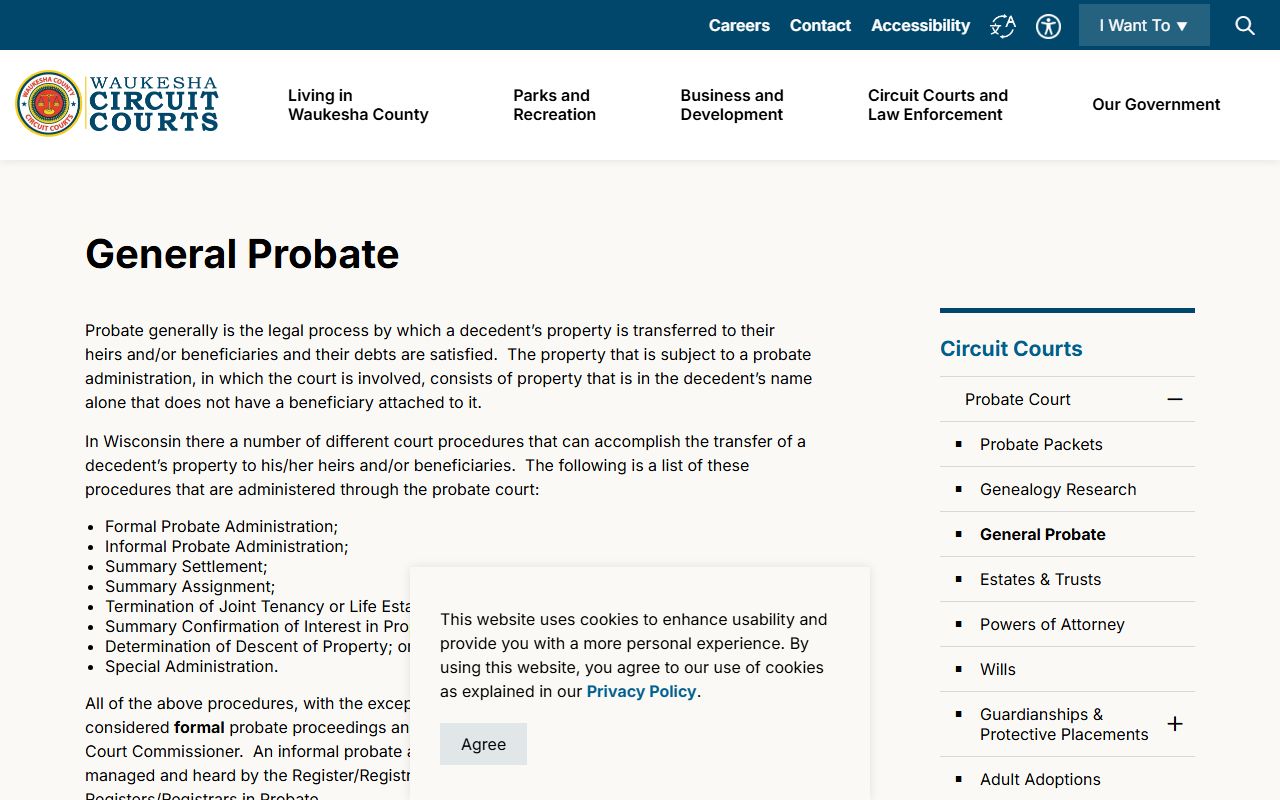
The county's general probate page explains how Wisconsin probate works in the county.
Probate Terms Defined
Probate paperwork is full of terms that everyday readers rarely meet. A few definitions clear up most of the confusion before you open a file. The list below covers the words you will see most in a Waukesha County probate record.
- Testator
- The person who made the will.
- Executor
- The person named to carry out a will, also called a personal representative.
- Intestate
- Dying without a valid will, which sends the estate through state default rules.
- Guardianship
- A court arrangement where someone is appointed to make decisions for a person who cannot.
- Conservatorship
- Court oversight of a person's finances or property, often for someone unable to manage them.
How to Search Waukesha County Probate Records
Public probate files can be searched on Wisconsin Circuit Court Access, the same portal used for other circuit court cases. You search by county, case number, or the name of the decedent or party. On-site public access computers in the Probate Division also show Waukesha County case information.
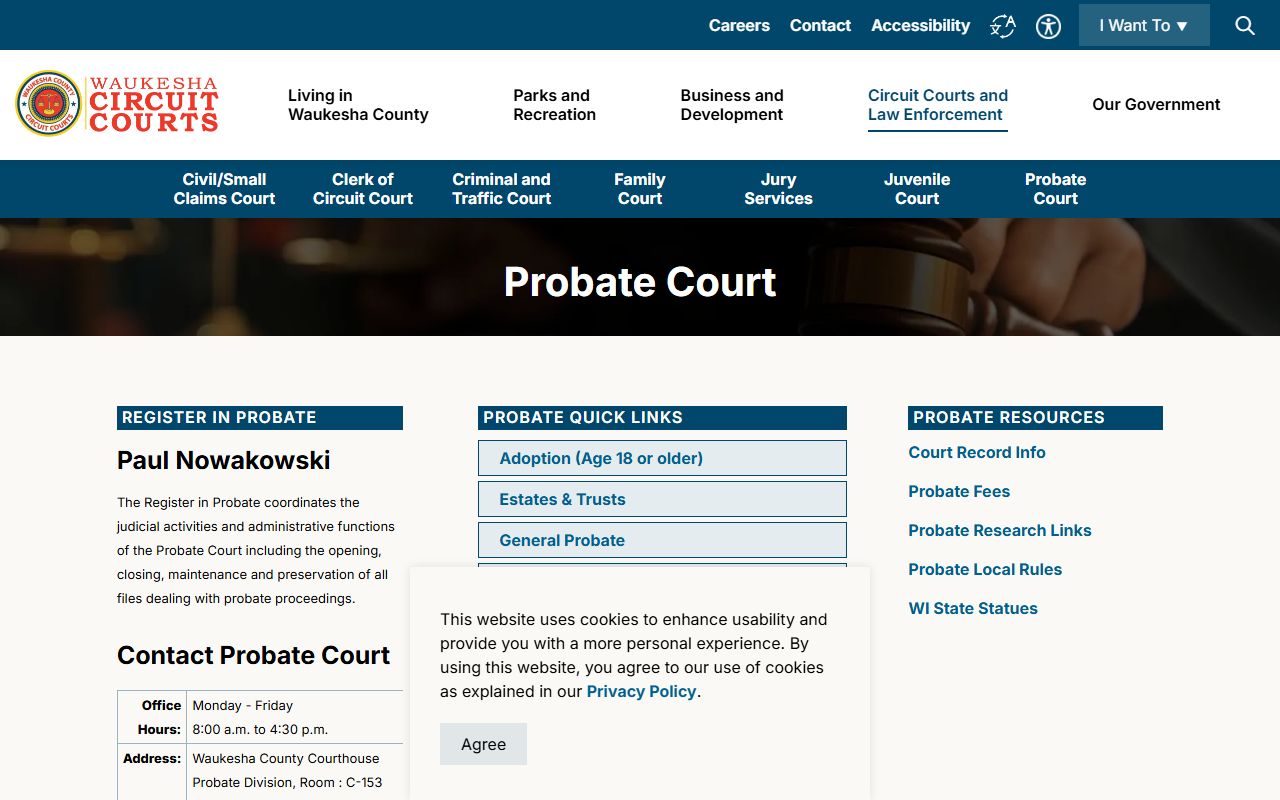
The county's Probate Court page lists the Register in Probate contact and quick links.
- Open WCCA and set the county to Waukesha.
- Search by case number, or by the decedent or party name.
- Filter by probate case type where the option appears.
- Open the case to view filings, hearings, and status.
- For copies, contact the Probate Division at 262-548-7468.
Probate Court in Waukesha County
There is one probate office for the county, run by the Register in Probate inside the circuit court. The office handles informal probate hearings and supports the formal proceedings heard by a judge or commissioner. Email is for inquiries only, since filings cannot be accepted by email, and the office asks users to review the probate local rules before faxing anything.
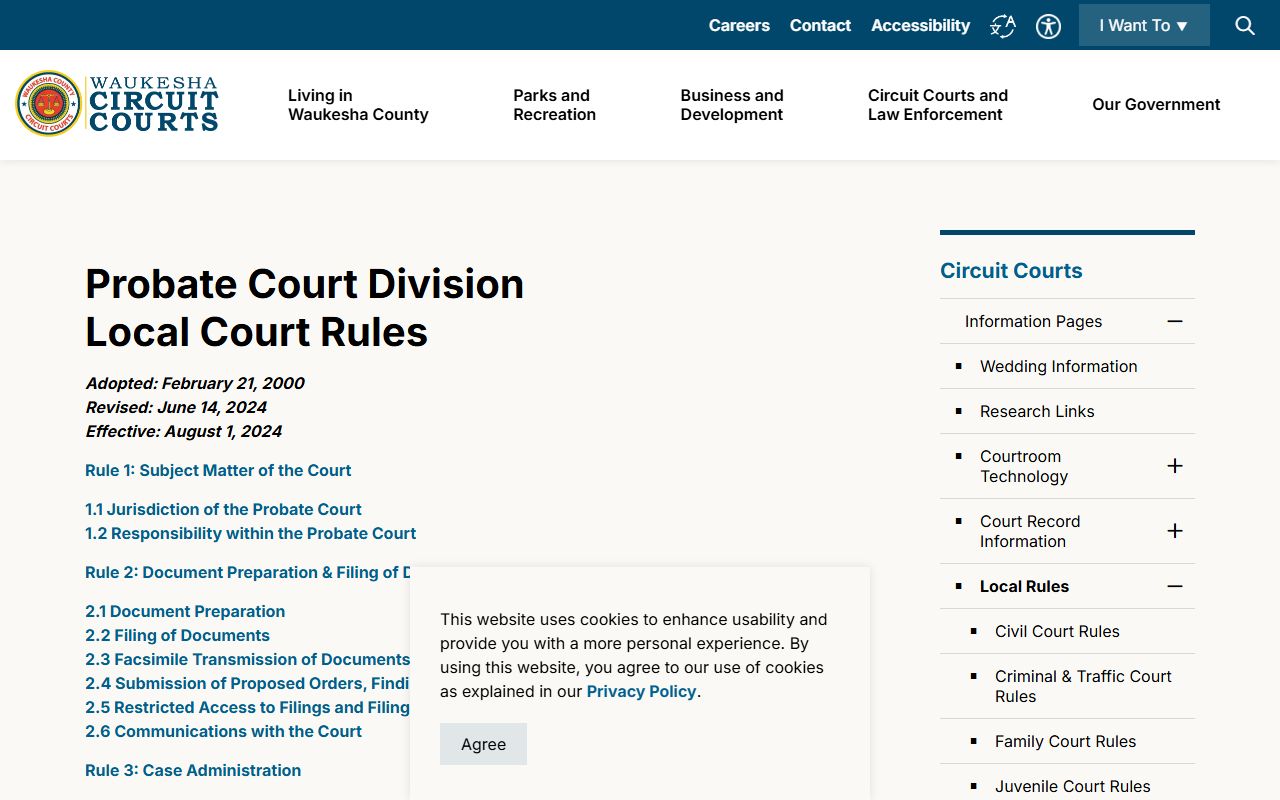
The probate local rules page covers filing format, wills, bonds, and fax rules.
Register in Probate
Probate Division, Room C-153
515 W. Moreland Blvd.
Waukesha, WI 53188
262-548-7468
Paul Nowakowski, Register in Probate
Probate Filing and Copy Fees
Probate fees run a little lower than the other court divisions. Copies and certification are priced per page and per document, and a staff search is charged per name. The table shows the main probate fees.
| Item | Amount |
|---|---|
| Probate copy per page | $1.00 |
| Probate certification per document | $3.00 |
| Probate record search per name | $4.00 |
Note: Email filings are not accepted in Probate, and the office asks filers to review Local Rule 2.3 before sending anything by fax. Email is for questions only, so plan to file in person, by mail, or through the proper channel the division directs.
Probate Procedures in Waukesha County
Wisconsin offers several probate paths, and the right one depends on the estate. All of them except informal probate are formal proceedings held before a judge or court commissioner. Informal probate is an administrative process managed by the Register or Registrar in Probate. Choosing the correct procedure early saves time and filing fees.
- Formal probate administration.
- Informal probate administration.
- Summary settlement and summary assignment.
- Termination of joint tenancy or life estate.
- Determination of descent and special administration.
If a will is filed under the no-probate statute, the local rules require an Affidavit of No Probate or a letter with the decedent's full name, dates of birth and death, the will's execution date, and the address at death.
A typical estate moves through a familiar sequence. The person seeking appointment files to open the case and, where one exists, files the original will. The court issues letters appointing a personal representative, who then gives notice to interested persons and creditors. After that comes an inventory of assets, handling of claims, debts, and taxes, distribution to heirs, and a final account that closes the estate. Each of those steps lands on the case docket as it happens, which is what a probate search shows.
The local rules also set format requirements that trip up first-time filers. Papers must be typed or legibly handwritten, filed on letter-size paper except for items like wills and certified death certificates, and printed on one side except for two-sided court forms. Anything that opens a case must include the filer's name, address, and phone number.
What Waukesha County Probate Records Show
A probate file tracks an estate from opening to closing. Early documents identify the decedent or ward and the person seeking appointment. Later filings handle notice to creditors, an inventory of assets, claims, accounting, and the final distribution. The case docket logs each step in date order, the same way other circuit court cases do.
Guardianship and protective placement files follow a different arc, with petitions, evaluations, and court orders about a person's care or finances. Much of a standard estate file is public, but sensitive medical and financial materials in guardianship and protective cases may be sealed or limited under state law.
The parties in a probate case carry titles you will not see in other courts. The decedent is the person who died. The personal representative, or executor, manages the estate. Heirs and beneficiaries are the people who stand to receive property. In a guardianship, the ward is the protected person and the guardian is the appointed decision-maker. Reading these roles correctly is the key to following who is doing what in the file.
Restricted Probate Records
Not all probate material is open. Guardianship, protective placement, mental health, and sensitive medical or financial documents may be restricted, even when the case itself appears in a search. Adult adoption and certain confidential matters can also be closed. A WCCA entry may confirm a case exists without showing every document inside it.
When a record is restricted, viewing it usually requires a legal interest in the case or a court order. The Probate Division can explain what is public for a given file, but staff cannot give legal advice or open a sealed record on request.
The reason for the limits is protection. Guardianship and protective placement cases exist because a person may not be able to manage their own affairs, and the file can hold medical, psychological, and financial details that the law keeps private. Adult adoption records carry similar privacy weight. So a probate search that returns a sealed or limited case is working as designed, shielding the most sensitive parts while still confirming the case exists.