
How to Search Waukesha County Traffic Court Records
Traffic cases filed in the circuit court appear on Wisconsin Circuit Court Access, the same portal used for other cases. You can search by name or by case number, and the citation itself carries details you will need. The county's traffic FAQ explains how to read a citation and what to do next.
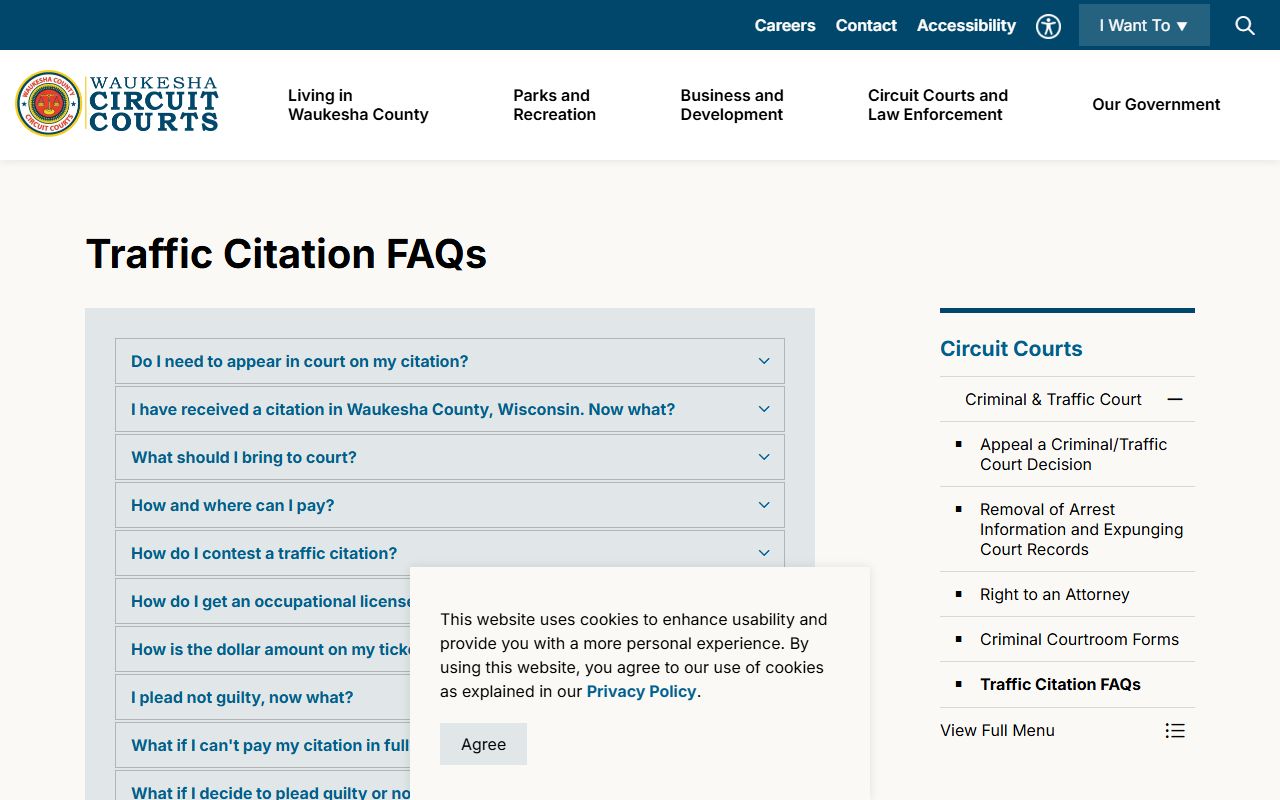
The county's traffic citation FAQ covers appearances, pleas, payments, and consequences.
- Read the citation for the court date, location, agency, and deposit amount.
- Open WCCA and set the county to Waukesha.
- Search by name, or by the citation or case number.
- Open the case to see the charge, plea, and disposition.
- Pay or contest before the court date as the citation directs.
Which Courts Handle Traffic Cases in Waukesha County
Most traffic citations filed in circuit court go to the Criminal/Traffic Division. The division sits in Room C-167 at the courthouse, with a mailing address at P.O. Box 1627, Waukesha, WI 53187-1627, and a general line of 262-548-7484. Some local ordinance citations start in a municipal court instead, and a municipal decision can be appealed to the circuit court.
So the same act, like a speeding ticket, can land in different places depending on which agency issued it and under what law. A citation written under state law goes to the circuit court. A city ordinance citation may go to that city's municipal court. The citation tells you the court and the date, which is why reading it carefully is the first step.
Types of Traffic Cases on Record
Traffic records cover a wide range, from minor forfeitures to criminal driving charges. The case-type code in the case number signals the category, and the more serious matters carry criminal codes rather than a simple forfeiture. The list below covers the common types.
- Speeding and moving violations issued as forfeitures.
- Equipment, registration, and non-moving citations.
- Operating after suspension or revocation.
- OWI and other criminal traffic charges.
- Failure to appear or pay, which can add a warrant or judgment.
What Waukesha County Traffic Court Records Show
A traffic case record packs the citation, the charge, and the financial outcome into one file. The fields below show what you can expect to see when you open a traffic case on WCCA. Some detail, like points, ties into the separate driver record rather than the court file.
| Field | What It Shows |
|---|---|
| Citation / case number | The ticket and court case identifiers. |
| Issuing agency | The police or sheriff agency that wrote the citation. |
| Violation and court date | When the offense occurred and the court appearance date. |
| Charge and statute | The violation description and the law cited. |
| Deposit / forfeiture | The amount due and any added costs or surcharges. |
| Plea and disposition | How the driver responded and how the case ended. |
| Financial ledger | Payments, balance, and any payment plan. |
Searching by Citation Number vs by Name
You can find a traffic case two ways, and the better choice depends on what you have. A citation number is exact and points straight to the ticket. A name search is broader and can return more than one case, especially for a common name. The table lays out the search fields.
| Field | Type | Notes |
|---|---|---|
| Citation number | Text | Exact match from the printed ticket. |
| Case number | Text | WCCA case format if filed in circuit court. |
| Last / First name | Text | Broader search; may return many results. |
| County | Dropdown | Select Waukesha. |
| Court date | Date | Appears on the citation and the case. |
Paying or Contesting a Waukesha County Traffic Ticket
The citation tells you whether you must appear. If it says "must appear," you have to show up at the initial appearance. If it does not, you can pay the deposit before the court date, or contest the ticket with a written not guilty plea. The plea must reach the Criminal/Traffic Division at least five days before the court date.
- Check whether the citation says "must appear."
- To pay, send the deposit online, by phone at 262-548-7497, by mail, or in person.
- To contest, submit a not guilty letter or form at least five days before the court date.
- After a not guilty plea, the court sets an adjourned initial appearance.
- To request a jury, pay the nonrefundable $36 jury fee within 10 days of the initial appearance.
If you cannot pay in full, bring a completed Financial Disclosure Statement and 25 percent of the total to the Business Center before or on the court date. Staff set a payment plan and add a $15 nonrefundable administrative fee based on ability to pay.
Public Access Laws for Traffic Court Records
Traffic court records are public, like other circuit court cases, under Wisconsin's open-court tradition. The open-court statute keeps proceedings public unless the law closes them, and the open-records law supports access to the files. You can read a traffic case summary on WCCA without giving a reason.
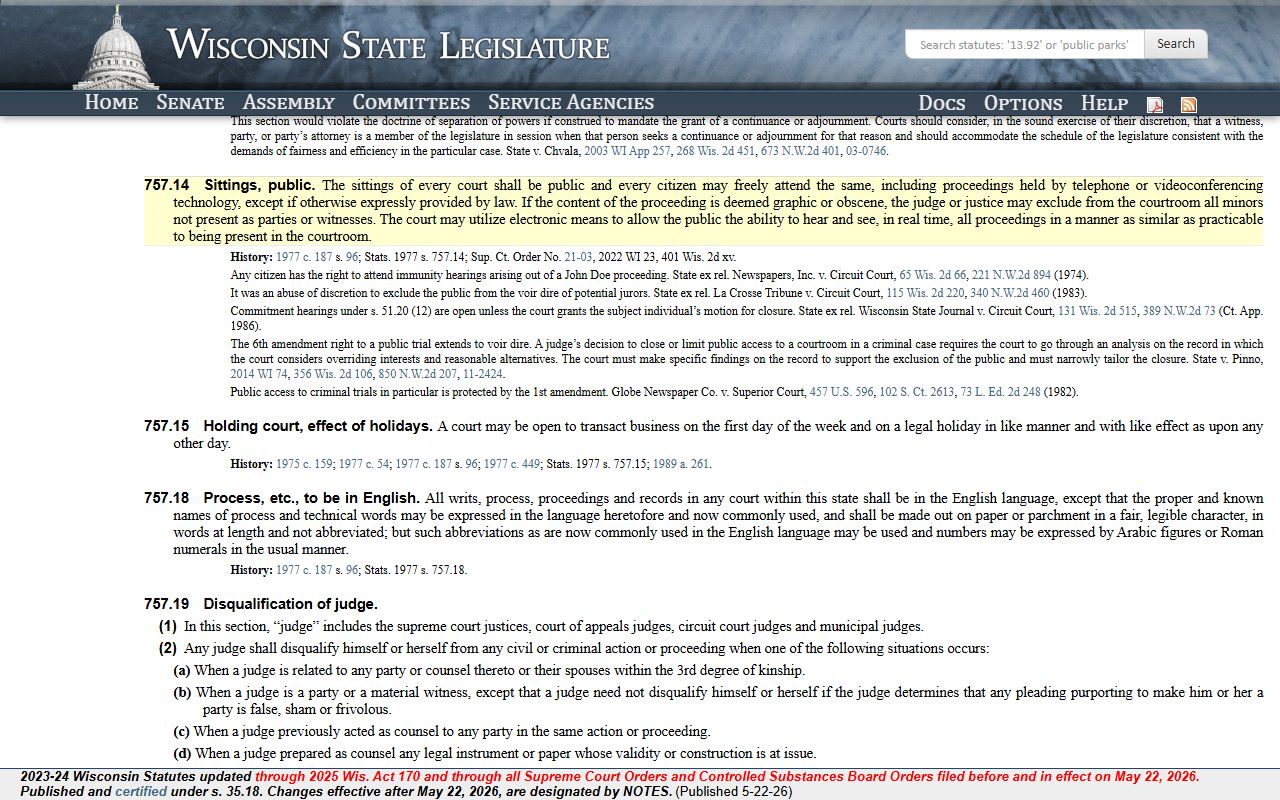
The open-court principle is set by Wis. Stat. § 757.14, which keeps court sittings public.
Certified copies of a traffic record still cost the standard per-page and certification fees, and a record can be redacted to protect personal identifiers. The public records page covers the broader access framework.
Court Traffic Records vs State Driver Records
This is the distinction that trips up most people. The court traffic record is the case file, kept by the circuit court. The state driver record is your driving history, kept by the Wisconsin DMV. They are separate files on separate systems, and they update on different timelines.
- Custodian
- Court record: Waukesha County Circuit Court. Driver record: Wisconsin DMV.
- What it shows
- Court record: citation, charge, plea, disposition, and payments. Driver record: license status, reportable convictions, and points.
- Where to access
- Court record: WCCA and the clerk. Driver record: a DMV record request.
- How to correct an error
- Court record: through the court case. Driver record: through the DMV.
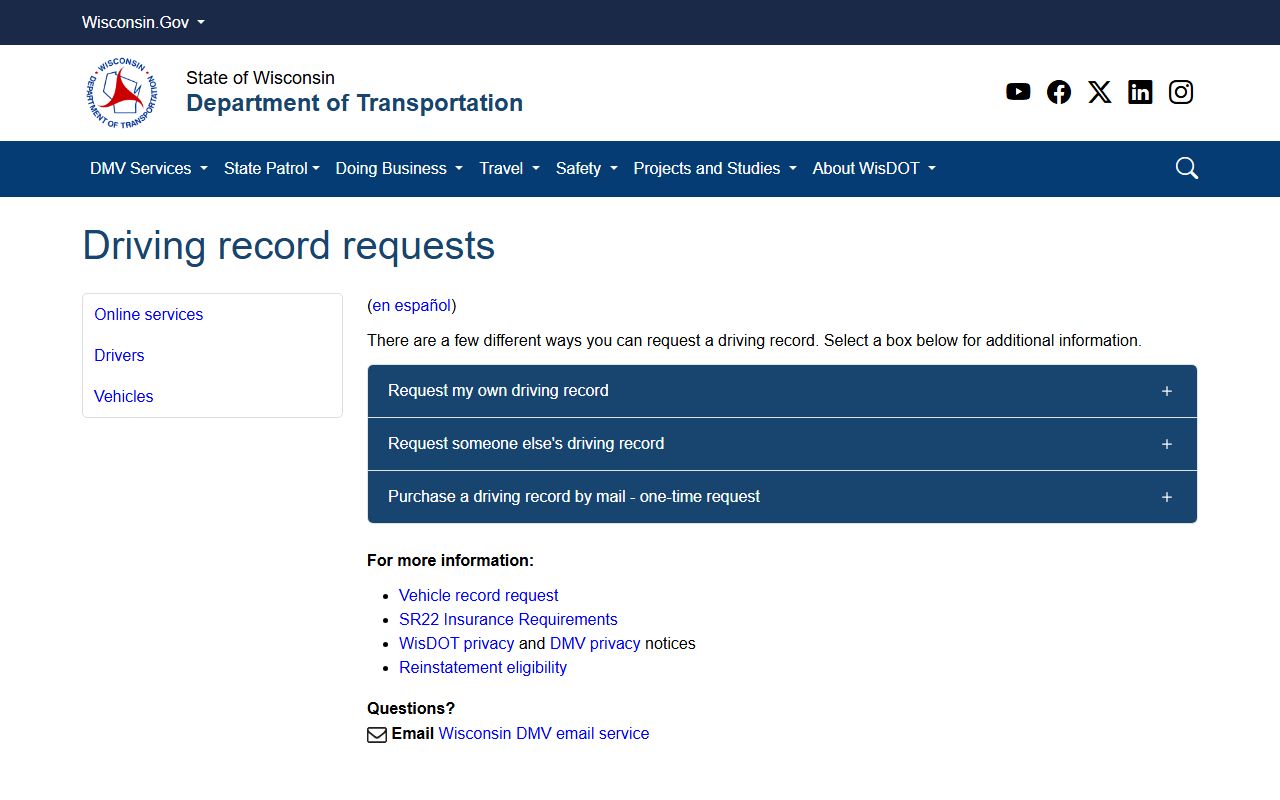
You can request your own driving record through the Wisconsin DMV driving record page.
CDL and Commercial Driver Records
Commercial drivers face tougher rules. A traffic disposition that is minor for a regular license can carry serious consequences for a commercial driver license. So a CDL holder should never assume a routine plea has the same effect on their commercial privileges.
Before resolving a ticket, a CDL holder should check the consequences with the Wisconsin DMV and, when the stakes are high, an attorney. The court record and the driver record both matter here, since a conviction reported to the DMV can affect a CDL even after the court case is closed.
DUI and OWI Cases
Operating while intoxicated, known in Wisconsin as OWI, is not an ordinary payable ticket. It is a criminal or serious traffic matter with its own penalties, and it often requires a court appearance. Do not treat an OWI citation like a speeding deposit you can simply mail in.
Because OWI overlaps with criminal records, the booking, charges, and case history may show across both the traffic and criminal systems. For the criminal side, including how arrest and conviction records work, see the arrest records page.
Diversion and Reducing a Traffic Charge
Some drivers can reduce the impact of a ticket, but the options are case-specific. The District Attorney runs diversion and deferred prosecution tracks that can change how a charge resolves, and a court may amend a charge after a plea. These are not automatic, and they depend on the offense and the driver's record.
Do not assume a defensive-driving course or a quick deal will erase points or keep a conviction off the driver record. Ask the court or an attorney what is actually available for your specific citation, since a paid forfeiture can still be reported to the DMV as a conviction.
Sealing or Expunging Traffic Records
Clearing a traffic record is limited. Wisconsin's expungement statute mainly targets certain criminal convictions, and it depends on the judge ordering expungement at sentencing and the person completing the sentence. A routine traffic forfeiture is generally not expunged the way a qualifying criminal conviction can be.
Paying a ticket does not remove it from the record, and a reportable conviction can still reach the DMV. If you believe a record is wrong, the fix runs through the court for the case file and through the DMV for the driver record. An attorney can advise whether any clearing option fits your situation.
Fees for Traffic Record Copies
Traffic court fees follow the same schedule as other court records, with a few traffic-specific charges. The table shows the common amounts, including the jury fee and the time-to-pay administrative fee.
| Item | Amount |
|---|---|
| Court copy per page | $1.25 |
| Certification per document | $5.00 |
| Jury fee (nonrefundable) | $36.00 |
| Time-to-pay administrative fee | $15.00 |
| DMV own driving record | $5.00 |
Note: A court copy of the case is different from a DMV driving record, and each carries its own fee and request process.