
About the Waukesha County Clerk's Office
The Clerk of Circuit Court is an elected official who serves a four-year term. The current clerk is Monica Paz. The office sits in the Waukesha County Courthouse and is open weekdays from 8:00 a.m. to 4:30 p.m. By statute, the clerk is the custodian of court records, which means the office holds the official case files for the county's circuit court.
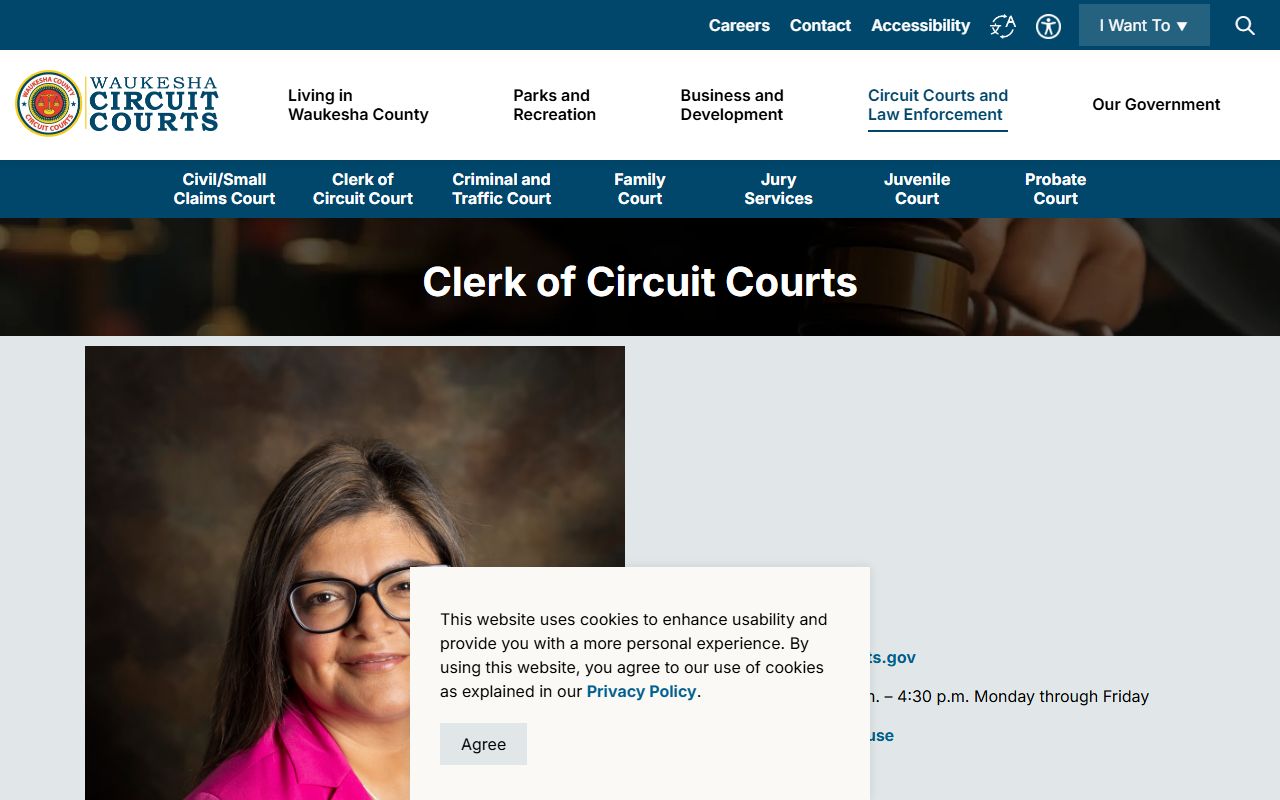
The county's Clerk of Circuit Court page lists the clerk's contact and role.
Wisconsin sets the clerk's duties by statute, which is why the role looks similar from county to county. The office is the central point where filings enter the court system and where the official record of each case is built and kept. When you read a case on WCCA, you are seeing a summary of the very record the clerk maintains in the courthouse.
Clerk of Circuit Court
515 W. Moreland Blvd.
Waukesha, WI 53188
262-970-6676
Mon-Fri 8:00 a.m. to 4:30 p.m.
Monica.Paz@wicourts.gov
What the Clerk Does in Waukesha County
The clerk wears several hats. The office keeps a record of all documents filed with the courts and a record of court proceedings. It collects fees, fines, forfeitures, and statutory charges. It manages jury service for the county. And it maintains confidentiality where a statute or court order requires it, while promoting reasonable public access to open records. That balance, open by default but confidential where the law requires, runs through everything the office does.
It helps to know what the clerk is not. The Clerk of Circuit Court handles court case records. It does not issue marriage licenses or record deeds. Those belong to the County Clerk and the Register of Deeds, covered on the County Clerk and Register of Deeds page. Keeping the two clerk roles straight saves a trip to the wrong counter.
As an elected office, the clerk answers to county voters, not to a single judge. That independence matters for records, because the clerk must keep and produce the file regardless of how a case turned out. The office also works closely with the 12 circuit court branches, the court commissioners, and the divisions, coordinating filings, hearings, and the flow of paper and electronic records through the courthouse.
How to Request a Certified Copy
A certified copy is the official, court-stamped version of a document, and it is what courts and agencies accept as proof. A plain copy is fine for reference, but a legal use almost always needs certification. The steps below get you there.
- Find the case on WCCA and note the case number.
- Identify the division that holds the case, such as Civil or Criminal/Traffic.
- Contact that division, in person or by mail, with the case number.
- Ask for the specific document and request certification.
- Pay $1.25 per page plus $5.00 to certify the document.
For a transcript, contact the court reporter for the judge who heard the case if no transcript exists yet, and give the hearing date and case number. If a transcript already exists, the clerk can sell a certified copy at the per-page rate, while the reporter often offers a lower per-page price for an uncertified copy.
Plan around the office hours. Counter requests are handled weekdays from 8:00 a.m. to 4:30 p.m., and a mailed request takes longer because of delivery and processing both ways. For an older case stored off site, ask early, since the standard retrieval runs on a 72-hour window unless you pay the rush fee.
Records Request Fields
Whether you request a copy in person or by mail, the same details make the search quick. The table lists what to include so the clerk can pull the right file without follow-up. The more precise the request, the less time staff spend hunting, and the sooner the certified copy is in your hands.
| Field | Required | Notes |
|---|---|---|
| Case number | Recommended | The fastest way to locate a file. |
| Party name | Yes if no case number | Last and first name. |
| Division | Helpful | Civil, Criminal/Traffic, Family, Probate. |
| Document requested | Yes | Name the specific filing or order. |
| Certified or plain copy | Yes | Certification costs more. |
| Requester contact | Yes for mail | For return of copies. |
Waukesha County Clerk Fees
The clerk charges statutory fees for copies, certification, and searches. Probate runs a little lower than the other divisions. The table collects the amounts that come up most often.
| Item | Amount |
|---|---|
| Copy per page | $1.25 |
| Certification per document | $5.00 |
| Record search per name | $5.00 |
| Probate copy per page | $1.00 |
| Probate certification | $3.00 |
| Emergency off-site retrieval | $22.75 per trip |
Note: A normal off-site records request is usually filled within 72 hours at no retrieval charge, so order older files in advance.
Division Contacts and Public Access Computers
The clerk's work is split across divisions, each with its own counter and phone line. Public access computers sit in the Business Center and the Civil, Criminal/Traffic, Family, and Probate divisions, and they show Waukesha County case information. Reaching the right division directly is faster than the main line for a specific case. The computers are limited to Waukesha County case information, so a search for another county's records still goes through WCCA.
| Division | Phone |
|---|---|
| Administration | 262-970-6676 |
| Business Center | 262-548-7497 |
| Civil / Small Claims | 262-548-7525 |
| Criminal / Traffic | 262-548-7484 |
| Family | 262-548-7544 |
| Probate | 262-548-7468 |
Jury Service and Court Finances
Two of the clerk's duties affect the public well beyond record copies. The office runs jury service for the county, from summoning potential jurors to coordinating the jury pool with the branches. If you receive a jury summons in the county, the clerk's jury coordinator is the contact for questions about service, scheduling, and deferral.
The clerk also handles court finances. The office collects filing fees, fines, forfeitures, restitution, and statutory charges, then accounts for the money and routes it as the law directs. That is why payments on a case, like a fine or a civil judgment, run through the clerk's divisions. The Business Center is the place to set up a payment plan or post bail during business hours.
Because the clerk both keeps the record and collects the money, a case file shows a financial ledger alongside the legal events. Fines, costs, payments, and balances appear in the record, which is useful when you need to confirm whether an obligation has been paid.
Mail, Online, and eFiling
Not every request happens at the counter. You can mail a copy request to the proper division with the case number and a return address. Online, WCCA lets you read case summaries for free, though it does not provide a certified copy. For filing documents, the county uses Wisconsin eFiling, and the clerk does not accept civil filings by email.
That last point trips up many filers. An email is fine to ask a question, but it is not a way to file a court document. Use the eFiling system or paper filing as the division directs. For the broader online search workflow, see the Waukesha County court records page.
Mailed requests should be specific and complete. Include the case number, the document you want, whether you need it certified, the fee, and a return address. A check should be made out as the division instructs. Sending a vague request, or one without payment, only adds a round of back-and-forth that slows the copy down.
Self-represented filers can also use the statewide court forms, which the clerk accepts when properly completed. The forms cover civil, family, small claims, and other matters, and pairing the right form with the correct division is the cleanest way to keep a filing on track.